DISASTER: Liam Rosenior Breaks TWO Unwanted Records as Chelsea Collapse vs Paris Saint-Germain
Chelsea hit historic lows in the Champions League as early goals, defensive chaos, and fan backlash pile pressure on Rosenior’s future.

It was supposed to be a night of belief and defiance at Stamford Bridge. Instead, it turned into one of the darkest evenings in recent memory for Chelsea and their head coach Liam Rosenior.
Coming into the second leg against Paris Saint-Germain, Chelsea already faced an uphill battle after their 5-2 defeat in Paris. Rosenior had called for courage, energy, and a fearless approach. But what followed in west London exposed deeper issues — tactical flaws, defensive vulnerability, and a growing disconnect between the team and its supporters.
Within just 14 minutes, Chelsea had already conceded twice. According to Squawka, that marks the earliest the club has ever let in two goals in a UEFA Champions League match. It is not the kind of record any manager wants attached to their name.
The previous unwanted benchmark belonged to Frank Lampard, whose Chelsea side conceded early during a chaotic group-stage clash against Ajax in the 2019/20 season. Even then, it took 20 minutes for the damage to unfold. Under Rosenior, it happened faster — and felt far more damaging.



The speed of PSG’s goals told its own story. Time and again, the French side found space in dangerous areas, slicing through Chelsea’s defensive structure with ease. The same problems seen in the first leg — open spaces, poor positioning, and a lack of defensive coordination — were once again brutally exposed.
For fans inside Stamford Bridge, patience quickly ran out.
Barely 15 minutes into the match, sections of the home crowd were already venting their frustration in a way that spoke volumes. Chants urging PSG to shoot and score more goals echoed around the stadium — a rare and painful sign of discontent directed at their own team.
It was not just the scoreline that hurt; it was the manner of the performance.
Chelsea looked fragile, uncertain, and unable to cope with PSG’s attacking movement. Every forward run by the visitors seemed to carry danger, while the home side struggled to impose themselves or regain control.
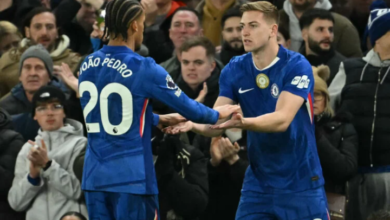
As if the situation was not already grim, another blow followed when Trevoh Chalobah was stretchered off with an injury. The defender’s exit only added to an already growing list of concerns for Rosenior, particularly in a backline that has lacked stability throughout the campaign.
By the final whistle, the damage extended beyond just one game.
Chelsea had now conceded eight goals across the two legs — the first time in their history that they have allowed so many in a Champions League knockout tie. It is a statistic that highlights not just a bad night, but a deeper structural problem within the team.
For Rosenior, the implications are serious.
What began as a promising project has now reached a critical point. Results have dipped, performances have become inconsistent, and confidence — both on the pitch and in the stands — appears to be fading. In the Premier League, Chelsea have managed just one win in their last five matches, further increasing the pressure on the manager.
From a tactical perspective, questions are being asked about Rosenior’s approach. His commitment to an open, attacking style has brought moments of excitement, but it has also left the team exposed. Against top-level opposition like PSG, those weaknesses are punished quickly and ruthlessly.
There is also the issue of adaptability. Critics argue that Rosenior has been slow to adjust when games begin to slip away, often sticking to his initial plan even when it is clearly not working. At this level, flexibility is essential — and its absence can be costly.
Behind the scenes, uncertainty is growing.
Reports suggest that the Chelsea board is beginning to have doubts about the long-term direction under Rosenior. While no immediate decision has been confirmed, the pressure is mounting with each disappointing result.
Names are already being mentioned as potential replacements, including Gary O’Neil. Whether those rumours develop into something more concrete remains to be seen, but their emergence reflects the growing sense that Rosenior’s position is no longer secure.
If changes were to be made, he would become yet another managerial casualty in the Clearlake era — a period marked by frequent transitions and a search for stability that has so far remained elusive.
And yet, football can change quickly.
Rosenior still has time to respond. A strong run of results, a tightening of the defence, and a clearer tactical identity could shift the narrative once again. But the margin for error is now extremely small.
For Chelsea, this was more than just a defeat. It was a night that exposed weaknesses, tested loyalty, and raised difficult questions about the future.
For Rosenior, it may well be the defining moment of his time at Stamford Bridge — the point where belief either begins to rebuild, or finally starts to fade.