 Minister
Inside the VAR Room: Why Brennan Johnson’s Goal vs Hull City Was Disallowed
The transparency surrounding officiating in top-flight English football reached another landmark moment as official communications and match-center details were released regarding Everton’s dramatic 2–2 Premier League draw against Hull City at the MKM Stadium.
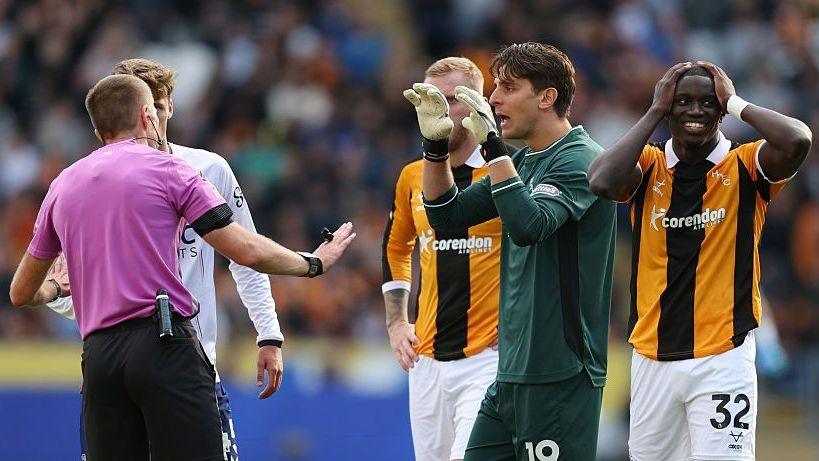
At the center of the debate was a 35th-minute goal scored by Everton forward Brennan Johnson. Initially awarded on the pitch, the strike was chalked off following a intervention by Video Assistant Referee Tim Wood and on-field referee Michael Salisbury.
The released match center details and officiating audio highlight the intense pressure, meticulous line-checking, and rapid decision-making required in subjective offside calls.
The Incident: A 35th-Minute Flashpoint
During a tightly contested first half, Everton launched an attack toward Hull City’s box. A long-range effort struck by Harrison Armstrong flew through a crowded penalty area. Brennan Johnson, wearing shirt number 22 for Everton, made a forward movement towards the ball alongside Hull City defender Ryan Giles (No. 3).
The ball nestled into the back of the net, prompting immediate celebrations from the visiting side. Referee Michael Salisbury originally signaled a goal.
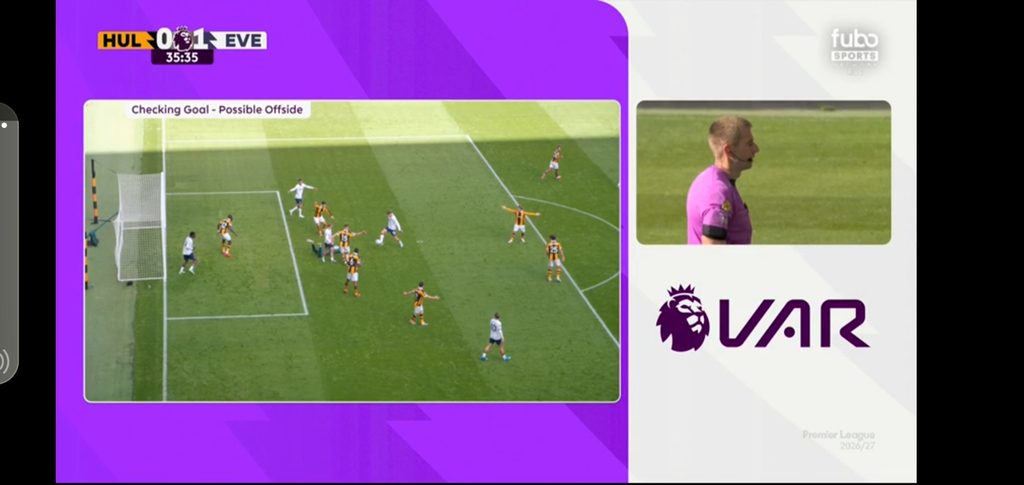
However, VAR Tim Wood immediately initiated a review to check two vital elements:
Whether Johnson was in an offside position at the precise frame Armstrong struck the ball.
Whether Johnson made an action that interfered with Hull defender Ryan Giles.
Fact vs. Subjectivity: The Need for the Pitchside Monitor
In standard offside decisions where a player directly touches the ball, VAR operates as a factual system—lines are drawn, and the decision is binary. However, because Johnson did not make direct contact with Armstrong’s initial shot before it entered or created the secondary goal action, the review moved into the realm of subjective interference.
Under IFAB Law 11, a player in an offside position is penalized if they are deemed to be interfering with an opponent by:
Preventing an opponent from playing or being able to play the ball by clearly obstructing their line of vision.
Challenging an opponent for the ball.
Clearly attempting to play a ball which is close when this action impacts an opponent.
Because determining “challenge for the ball” or “impact on an opponent” requires human judgment, VAR Tim Wood recommended an On-Field Review (OFR). Referee Salisbury was summoned to the pitchside monitor to evaluate whether Johnson’s physical presence and movement hindered Giles’s ability to clear or defend the shot.

Official Announcement & Match Center Clarification
Following Salisbury’s review at the monitor, he turned to the stadium to deliver his verdict, signaling a free-kick to Hull City and ruling the goal out.
Shortly after, the Premier League Match Centre issued an official statement outlining the exact rationale behind the overturn:
Premier League Match Centre Statement:
“#HULEVE – 35′ VAR OVERTURN. After VAR review, the referee overturned the original decision of goal to Everton – with Johnson in an offside position and deemed to be challenging an opponent for the ball.
REF: ‘Everton No. 22 is in an offside position and challenges Hull No. 3. Final decision is offside.'”

Analyzing the decision on BBC Radio 5 Live, former assistant referee Darren Cann commended the communication between the match officials, noting that the intervention was textbook:
”Brennan Johnson was in an offside position when the shot came in from Harrison Armstrong,” Cann explained. “Johnson then challenged Hull City’s Ryan Giles and therefore in law was interfering with an opponent. It was an excellent and correct intervention from VAR Tim Wood, who was also right to instruct referee Michael Salisbury to go to the monitor as this was a subjective offside decision, rather than a factual one.”
Match Outcome and Aftermath
The disallowed goal proved crucial in shaping the trajectory of the match. After a goalless first half, the game erupted in the second period. Joe Gelhardt opened the scoring for Hull before Everton responded through Kiernan Dewsbury-Hall and Thierno Barry. A 74th-minute goal by Mohamed Belloumi earned Hull City a 2–2 draw, leaving Everton to ponder what might have been had Johnson been positioned just a few inches deeper.

 Thewolf
 Minister
 shakur
 xy
xy